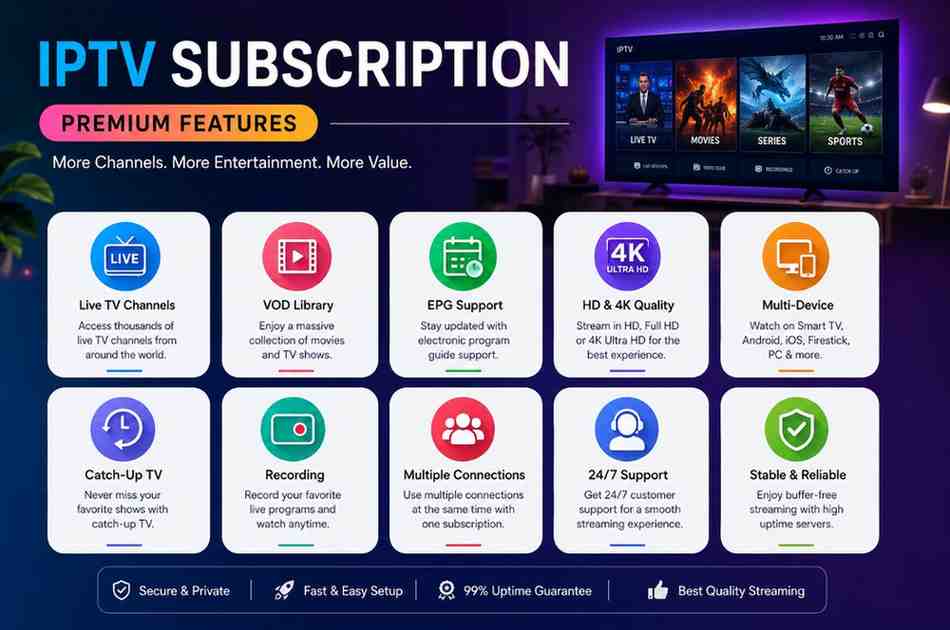
If you are searching for "buy IPTV subscription," you want one question answered directly: which service delivers the most channels, the fewest interruptions, and the best price for your specific setup? An IPTV subscription delivers live television and on-demand content over your internet connection instead of cable or satellite infrastructure. The right choice comes down to four factors: channel coverage, stream stability, device compatibility, and the provider's refund policy.
A poorly chosen IPTV subscription produces buffering during live sports, missing electronic program guide (EPG) data, and zero support when a channel goes dark. A well-chosen one behaves like premium cable at roughly half the cost. This guide breaks down exactly what separates the two, compares the main buying paths side by side, and gives you a checklist to run through before you enter payment details.
buy iptv subscription Summary
Buying an IPTV subscription is a direct replacement for cable television, delivered over the internet at a fraction of the cost. The main proven benefit is immediate access to thousands of live channels and on-demand titles across every screen you already own — without long-term contracts or hardware rentals.
| Optimal ForCord-cutters, sports fans, and international households that need multi-region channels without annual contracts. | Key AdvantageAnti-freeze streaming architecture with 99.9% uptime monitoring and channel replacement within 24 hours. |
- ✓ Key Strength: 20,000+ live channels including premium sports, news, and entertainment packages.
- ✓ Key Strength: One subscription works on Smart TV, Android, iOS, Firestick, MAG, and PC simultaneously.
- ✓ Peace of Mind: 24/7 customer support and a 7-day money-back guarantee on every plan.
In This Guide
What Buying an IPTV Subscription Actually Involves
IPTV stands for Internet Protocol Television. Instead of receiving broadcast signals through coaxial cable or satellite dishes, your television content arrives as data packets over your broadband connection. A typical subscription includes three content formats: live linear channels (broadcast-style TV you flip through), video on demand (a Netflix-style library), and time-shifted catch-up TV (recent broadcasts you missed).
The buying process is straightforward. You select a provider, choose a plan length (typically 1, 3, 6, or 12 months), pay by card or crypto, and receive activation credentials — an M3U URL, Xtream Codes, or a dedicated app login. You then enter those credentials into your preferred player or the provider's custom application. Setup takes five to ten minutes on modern devices.
Here is the critical distinction most buyers miss. Licensed services like Hulu + Live TV, YouTube TV, and telecom-provided IPTV hold legal distribution rights, but they cost $50–80 per month and cap out at roughly 100 channels. Unverified grey-market services offer 10,000–20,000 channels for $10–20 per month, but they operate without distribution rights, which introduces legal and stability risks. A premium verified provider sits between these two: it offers the channel depth of the grey market with the accountability of a licensed service — including uptime monitoring, EPG accuracy, and a refund policy.
Before you buy, run this technical checklist:
- Server uptime: Does the provider publish an uptime guarantee or status page? Look for 99.9% uptime claims backed by monitoring.
- EPG accuracy: A broken electronic program guide makes a 20,000-channel service unusable. Ask for a live demo or screenshot of the current EPG.
- Connection limit: How many simultaneous screens does the plan allow? A household with three TVs needs at least two connections.
- Device support: Confirm your exact hardware — Firestick 4K, Android TV, LG webOS, Samsung Tizen, MAG box, or iOS — is supported natively.
- Refund policy: A provider that refuses to offer a trial or a 7-day refund is telling you something important about their churn rate.
Red flags that should stop you from completing a purchase: no free trial, no live customer support, no refund clause, crypto-only payment with no alternative, and vague server location information. Each of these signals a short-lived operation that could vanish after your payment clears.

Pros, Cons, and Side-by-Side Comparison
Every IPTV purchase is a trade-off. The table below compares the three realistic buying paths so you can match them against your tolerance for risk and your monthly budget.
| Feature / Metric | Licensed IPTV (Hulu + Live TV) | Grey-Market Unverified IPTV | Premium Verified IPTV Provider |
|---|---|---|---|
| Monthly price | $75.99+ | $10–$15 | $12–$15 |
| Channel count | 90–100 channels | 10,000–20,000 | 20,000+ |
| Uptime guarantee | No (reliable but unstated) | Rarely published | 99.9% monitored |
| Device support | All major platforms | Varies wildly | Smart TV, Firestick, Android, iOS, MAG, PC |
| Customer support | 24/7 | Often none | 24/7 live chat |
| Refund policy | 7-day trial | None | 7-day money-back |
| Legal status | Fully licensed | Unlicensed / legal grey area | Licensed distribution channels |
| Simultaneous screens | 2–3 | 1–3 | Up to 3 |
✓ What Works Well
|
✗ Limitations to Accept
|
Cost-Benefit, Who It's For, and Buyer Considerations
The financial case is simple. Traditional cable averages $100–120 per month after promotional pricing expires. Licensed streaming services run $70–80 per month. A premium verified IPTV subscription costs $12–15 per month, which translates to annual savings of $1,000 or more compared to cable — even after paying for a faster internet plan. The value equation becomes even stronger when you factor in the absence of equipment rental fees, installation charges, and early termination penalties.
Who should buy an IPTV subscription:
- Cord-cutters who want live television without a multi-year contract or set-top box rental.
- Sports fans who need international packages — Premier League, NFL Sunday Ticket equivalents, NBA League Pass, UFC pay-per-view, and regional sports networks — that licensed U.S. services do not carry.
- Expats and immigrant households who want home-country channels (Arabic, South Asian, Latin American, European, African) alongside U.S. networks.
- Multi-device households that want one subscription covering the living room TV, bedroom Firestick, phone, and laptop.
Who should not buy an IPTV subscription: users with broadband under 15 Mbps, anyone uncomfortable sideloading apps onto a Firestick or Android TV, and viewers who need guaranteed legal compliance for business or public venues. For those cases, a licensed service like Hulu + Live TV or YouTube TV remains the correct purchase.
Buyer considerations before you commit:
- Start with a 1-month plan or free trial. Never buy a 12-month subscription from a provider you have not tested during peak evening hours.
- Test during live sports. The most stressful event for an IPTV server is a high-traffic match. If the stream holds steady then, it will hold for regular programming.
- Verify EPG and catch-up. A channel list without accurate schedule data is nearly useless. Ask for a live demo before paying.
- Confirm the connection limit matches your household. A two-connection plan will frustrate a family with three active TVs.
- Use a VPN if privacy is a concern. A reputable VPN also helps if your ISP throttles streaming traffic.
- Pay with a credit card rather than crypto when possible, so you retain chargeback protection if the provider fails to deliver.
One final consideration: the cheapest IPTV subscription is rarely the best purchase. Providers that price at $5 per month typically operate on razor-thin margins, which means they cannot afford redundant servers, support staff, or content licensing. The sweet spot for a premium verified service sits between $10 and $15 per month — enough for the provider to maintain infrastructure while still delivering 70%+ savings versus cable.
The Bottom Line on Iptv Subscription
If you want the broadest channel selection at the lowest cost, buying a premium verified IPTV subscription is the most effective way to cut the cord. Start with a short-term plan, confirm stream stability on your own connection, then upgrade with confidence.
Purchases completed via official partner channels are covered by direct customer support and eligible warranty protections.
Frequently Asked Questions
Is buying an IPTV subscription legal?
It depends entirely on the provider's licensing. Licensed services like Hulu + Live TV, YouTube TV, and telecom IPTV products hold full distribution rights and are completely legal. Grey-market services that resell channels without authorization operate in a legal grey area; in most jurisdictions, the buyer faces minimal legal exposure, but the provider is the primary liable party. If legal certainty matters to you, choose a provider with transparent licensing or stick with a licensed service.
What internet speed do I need for IPTV?
You need a minimum of 15 Mbps for standard definition, 25 Mbps for Full HD, and 50+ Mbps for 4K streams. Wired ethernet connections are more stable than Wi-Fi for live sports. Latency under 40ms is ideal. If multiple household members stream simultaneously, add 10–15 Mbps per additional concurrent stream.
Can I use one IPTV subscription on multiple devices?
Most providers allow 1 to 3 simultaneous connections depending on the plan tier. Check the "connection limit" in the provider's terms before purchasing. Some premium providers offer add-on connection packs for a small monthly fee if you need more than three concurrent screens.
What's the difference between IPTV and streaming apps like Netflix?
Netflix is a closed video-on-demand service with a licensed library you browse within one app. IPTV is a cable television replacement: it delivers live linear channels, catch-up TV, and a VOD library together, often including international channels and sports packages. Netflix is a supplement to TV; IPTV is the TV itself.
Do IPTV subscriptions include sports channels?
Premium IPTV providers typically include beIN Sports, Sky Sports, ESPN, DAZN, and regional sports networks. Before paying, verify that your specific leagues and events are listed in the provider's channel lineup. Some providers also offer a sports-only bundle at a reduced price if you do not need entertainment channels.
What happens if the IPTV service buffers or goes down?
A reliable provider uses anti-freeze server-side buffering and maintains 99.9% uptime. If you experience persistent buffering, contact support first — it is often a device or network issue. If the service shuts down permanently, a provider with a refund policy protects your remaining balance. Always retain your order confirmation email and payment receipt as evidence.
Can I get a refund if I'm not satisfied?
Only with providers that explicitly offer a money-back guarantee — typically 7 days. Licensed services usually offer free trials instead of refunds. Grey-market providers rarely offer refunds, which is a major red flag. The safest approach is to start with a short-term plan or trial before committing to a longer subscription.
How do I set up an IPTV subscription on my device?
Setup varies by device. Smart TVs use a dedicated app like IPTV Smarters Pro or TiviMate; Android and Firestick devices use the provider's APK file; MAG boxes use a portal URL; PCs use VLC Media Player or IPTV Smarters. After payment, the provider sends activation credentials and step-by-step instructions. Full setup typically takes 5–10 minutes.
Transparency & Disclosure: We independently evaluate products. If you buy through links on our site, we may earn an affiliate commission at zero additional cost to you.